
Rubber Expansion Joints
Single and double sphere rubber expansion joints absorbing vibration, thermal movement and installation misalignment in pipework — DIN/ANSI flanges, PN10/16/25.
Product samples Rubber Expansion Joints
Click any product to view a larger photo with dimensions and compound.
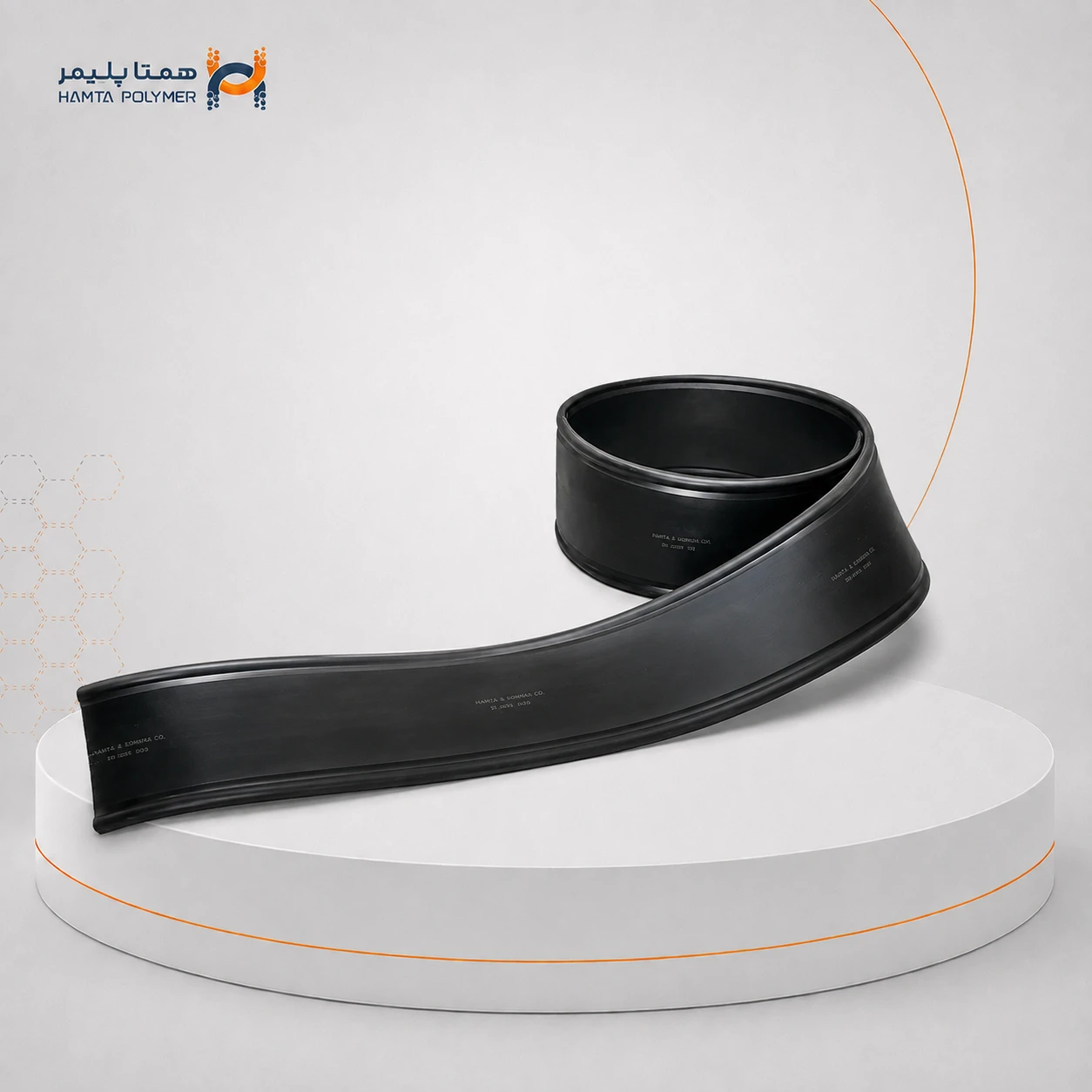 Rubber Expansion Joints
Strip & Profile Rubber Expansion Joint
A rubber expansion joint absorbs vibration, thermal growth and installation misalignment in pipework. Hamta Polymer's current series is the strip & profile rubber expansion joint — made to an approved drawing up to 7 m in EPDM, CR and other compounds matched to the line's temperature and media.
A rubber expansion joint absorbs vibration, compensates thermal growth and tolerates some installation misalignment in pipework. The actual vibration reduction and allowable movement depend on design, size, pressure, anchoring and installation conditions.
Hamta Polymer's current series is the strip & profile rubber expansion joint, manufactured to an approved drawing; spherical (single/double arch) designs can be evaluated per project.
Nominal pressure, allowable temperature, liner compound, reinforcement structure and test requirements must be declared per order in the datasheet or technical offer — no single figure generalizes across all sizes and compounds.
Where Rubber Expansion Joints are used across industries
Utilities & HVAC systems
Building cooling/heating circuits and chiller-pump vibration absorption.
Water & wastewater
Municipal and industrial water and sewage pumping stations.
Power plants
High-temperature steam lines (EPDM compound).
Petrochemicals
Chemical and hydrocarbon transfer lines (FKM/Viton compound).
Quality assurance for Rubber Expansion Joints
Hydrostatic test (when specified)
Reinforcement adhesion test
Dimensional conformity to the approved drawing(Per order specification)
Shore A hardness measurement(ASTM D2240)
Common failure patterns in Rubber Expansion Joints
Bulging or rupture of the sphere
Cause: Working pressure above rating, missing control anchors, or undersized reinforcement
Fix: Verify line pressure/anchors and upgrade reinforcement or pressure class
Cracking from over-articulation
Cause: Movement beyond the joint's allowance, or wrong choice of single vs double sphere
Fix: Measure actual movements and re-select type/size accordingly
Chemical degradation of the liner
Cause: Compound incompatible with the fluid or temperature
Fix: Re-select the liner compound against the actual media (table above)
How our Rubber Expansion Joints are produced
- 1
Receipt of pipeline specs (installation point, pressure, temperature, fluid type and expected movements)
- 2
Selection of strip/profile construction and compound against working pressure and environment
- 3
Arrangement of reinforcement plies to match the operating conditions
- 4
Manufacturing to the approved drawing followed by the agreed testing
- 5
Final customer approval, then production with per-batch quality control
For engineers and technical buyers — product types, the full material matrix and a precise selection guide.
Rubber Expansion Joints types available from Hamta Polymer
Strip & profile expansion joint
The current series: an elastomeric strip or profile made to the approved drawing, absorbing movement and vibration at the installation point — length up to 7 m per drawing or sample.
Compound matched to the line
EPDM for water, steam and weathering; CR for outdoor and HVAC duty; further compounds evaluated against the actual fluid and temperature.
Spherical designs (per project)
Single- and double-arch (sphere) constructions offer larger movement absorption; each project is engineered against pressure, size and required travel before quotation.
Made to drawing or sample
Length, width and cross-section follow your approved drawing; a physical sample of the installed joint is equally acceptable as the manufacturing basis.
Full engineering material matrix for Rubber Expansion Joints
A compound selection guide based on operating temperature, fluid type and mechanical demand — for industrial orders, match the material to the real service conditions.
| Compound | Operating temperature range | Fluid resistance | Key mechanical property |
|---|---|---|---|
| NR (Natural Rubber) | −20 to +80 °C | Water and air; low oil resistance | Highest elasticity and vibration absorption; suited to water and utility lines |
| EPDM | −40 to +120 °C | Hot water, steam, diluted acids and alkalis (not oils) | The primary choice for power-plant steam lines and sewage systems |
| CR (Neoprene) | −35 to +120 °C | Diluted mineral oils; good ozone and weathering resistance | Suited to outdoor installation and HVAC/heating plant rooms |
| FKM / Viton | −20 to +200 °C | Hydrocarbons, fuels and many aggressive chemicals | The option for petrochemical chemical-transfer lines at high temperature |
The listed ranges are general material selection guides; final service conditions must be reconciled with the fluid type, pressure, part geometry and order specifications.
How to choose the right Rubber Expansion Joints
Choose your expansion joint around four factors: (1) the installation point and its allowed movement (axial/lateral/angular); (2) line working pressure and temperature; (3) fluid type, which sets the compound (table above); (4) length, width and cross-section per the approved drawing. Our standard series is the strip & profile type; spherical constructions are engineered case by case where larger travel is required.
Frequently asked questions about Rubber Expansion Joints
No fixed percentage applies to all lines. The result depends on excitation frequency, joint stiffness, internal pressure, anchoring, size and installation method — sensitive applications should be evaluated by calculation or measured before and after installation.
Hamta Polymer's standard series is the strip/profile type made to approved drawings. Spherical single- or double-arch designs move more in axial and lateral directions but need engineered evaluation — we assess them per project against pressure, size and travel.
Fluid type and line temperature matter most: NR/EPDM for water and steam, CR for outdoor and HVAC service, and Viton/FKM for hot chemical and hydrocarbon lines.
Rubber joints offer far greater flexibility and vibration absorption than metallic bellows and are more economical at moderate pressures and temperatures. Metallic types are typically reserved for pressures and temperatures beyond rubber's operating range.
Yes. Declare the flange standard (DIN, ANSI or PN class) and we manufacture the joint to drill-match your existing pipework so it bolts straight on.
Other categories
The full rubber and polymer product range
Industrial O-Rings
7 products
Rubber Packing & Gaskets
7 products
Rubber Diaphragms
8 products
Conveyor Rollers
2 products
Shock & Vibration Dampers
8 products
Rubber Strips & Extruded Profiles
6 products
Silicone Rubber Parts
13 products
Flexible Rubber Couplings
4 products
Rubber Dust Boots & Bellows
2 products
Bonded Rubber-Metal Parts
6 products
Miscellaneous Industrial Rubber Parts
10 products
Valve Rubber Components
2 products
Medical & Lab Equipment Parts
5 products
Ready to order Rubber Expansion Joints?
Send us the dimensions, a drawing or a worn-out sample together with your media, temperature and pressure — our engineering team will come back with the fastest possible quotation and lead time.