
Rubber Dust Boots & Bellows
Accordion, conical and cylindrical rubber boots protecting shafts, pistons and joints from dust, water and oil — custom-built to your travel range.
Product samples Rubber Dust Boots & Bellows
Click any product to view a larger photo with dimensions and compound.
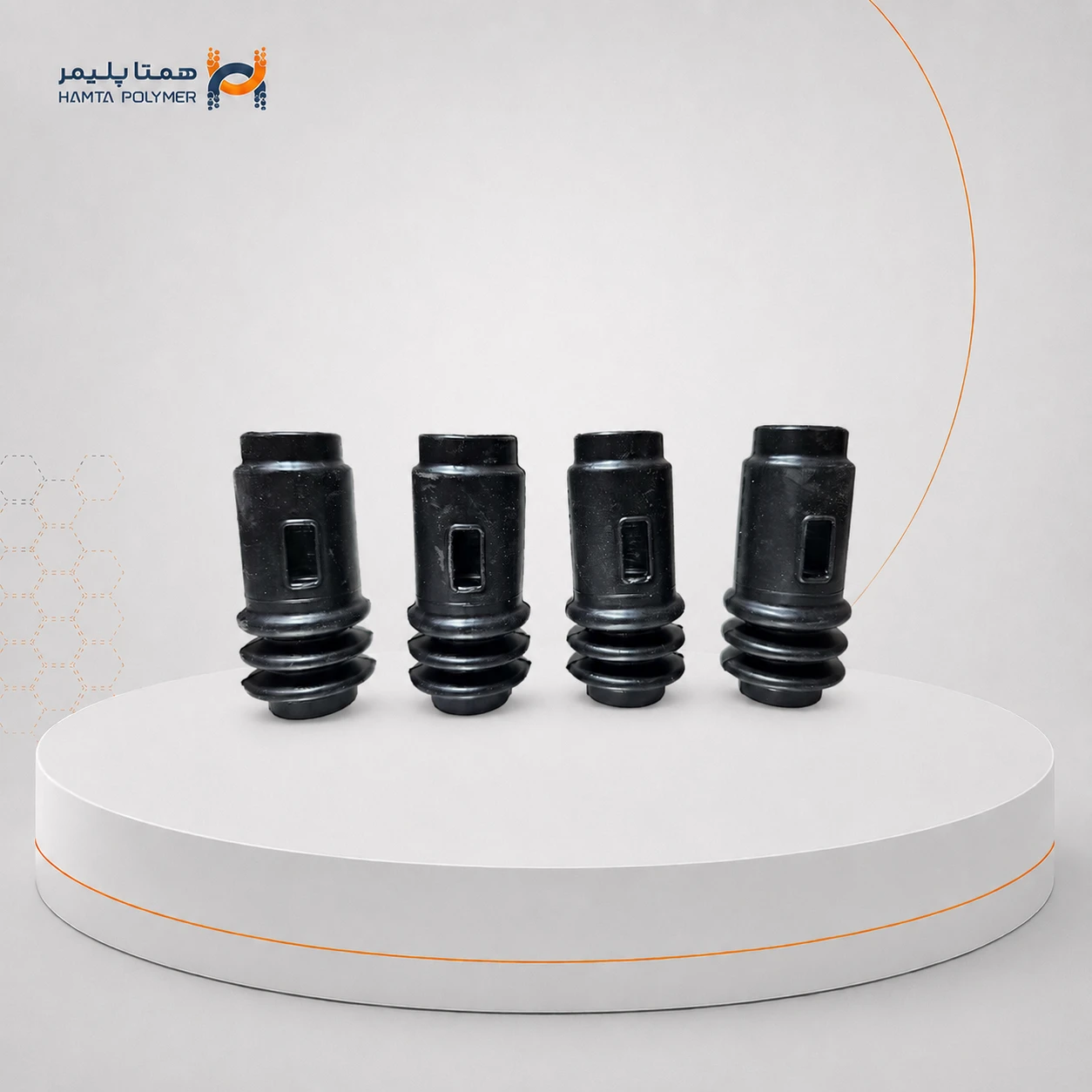 Rubber Dust Boots & Bellows
Vehicle Steering Shaft Dust Boot
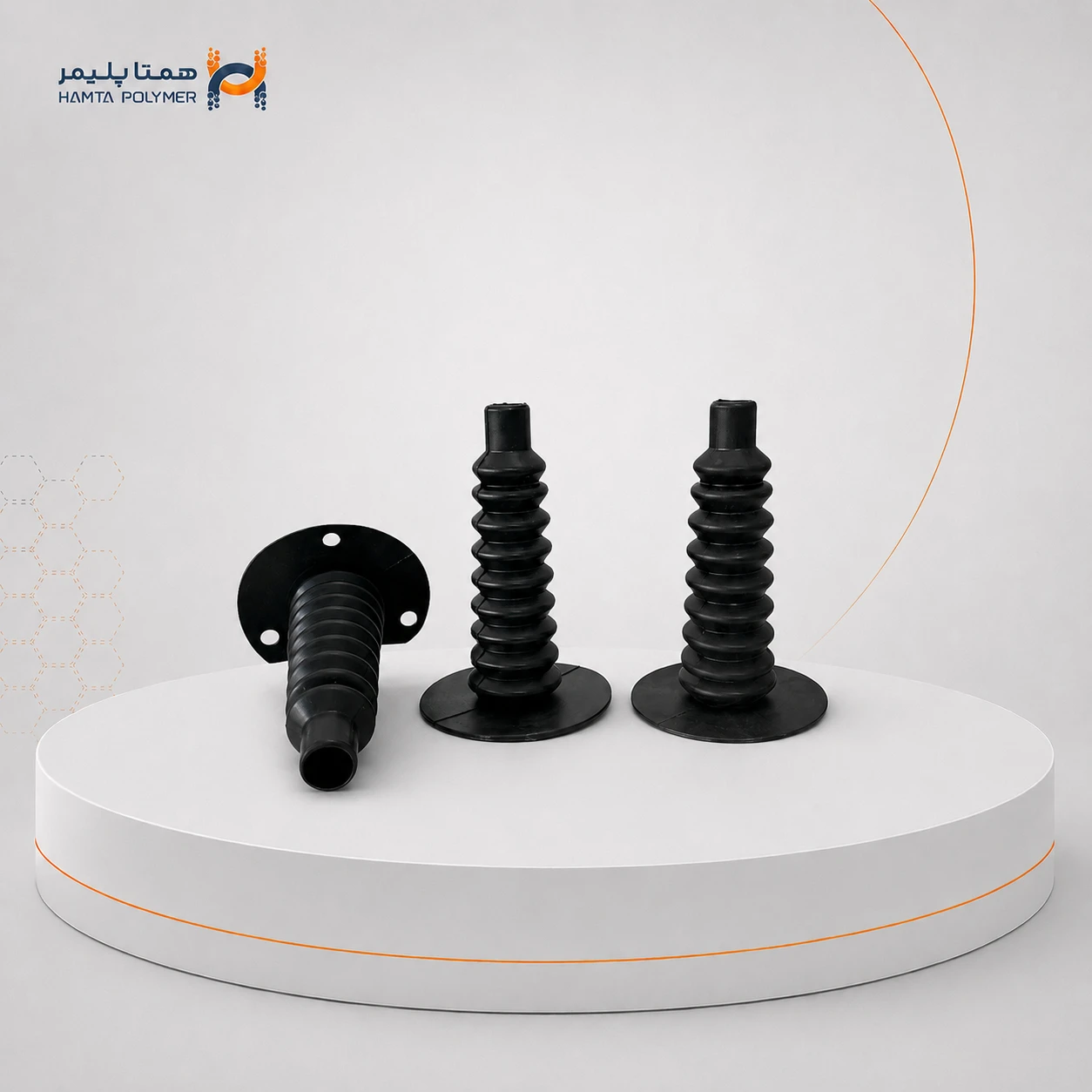 Rubber Dust Boots & Bellows
Industrial Accordion Bellows
A rubber dust boot (bellows) protects shafts, rods and joints from dust, water and oil while flexing through the stroke. Hamta Polymer makes accordion, conical and cylindrical boots in CR, NBR, NR and silicone — custom convolution counts matched to your travel range.
A rubber dust boot (bellows) shields shafts, pistons, cylinders and ball joints from dust, water, oil and other contaminants. Hamta Polymer produces accordion, conical and cylindrical boots; the number of convolutions, wall thickness and dimensions must be coordinated with the part's actual travel range.
For outdoor installation, ozone/UV resistance and temperature cycling tolerance matter most. An unsuitable compound or over-stretched convolutions are among the most common causes of early cracking.
Where Rubber Dust Boots & Bellows are used across industries
Automotive
CV joints, half-shafts, suspension, steering and driveshaft protection.
Machine tools
Protection of spindle axes and linear guide rails on CNC machines.
Hydraulics & pneumatics
Cylinder and piston-rod covers against industrial-environment dust.
Robotics & automation
Sealing industrial robot joints against contaminants and humidity.
Quality assurance for Rubber Dust Boots & Bellows
Ozone crack resistance(ASTM D1149)
Flex fatigue test
Shore A hardness measurement(ASTM D2240)
Tensile strength and elongation at break(ASTM D412)
Low-temperature flexibility
Common failure patterns in Rubber Dust Boots & Bellows
Cracking at the fold points
Cause: Ozone/UV exposure with a non-resistant compound, or over-compressed convolutions
Fix: Switch to an ozone-resistant compound (CR/silicone) and verify free length vs travel
Grease leakage
Cause: Torn convolutions or loose end fixation
Fix: Replace the boot immediately and re-torque the clamps to specification
Hardening and brittleness in winter
Cause: Compound's low-temperature limit above the ambient minimum
Fix: Move to a lower-Tg compound such as NR or silicone for cold climates
How our Rubber Dust Boots & Bellows are produced
- 1
Analysis of sample or drawing to define shaft diameter, extended length and required convolution count
- 2
Selection of compound according to installation environment (outdoor/industrial) and operating temperature
- 3
Design or adaptation of the compression mold for the convolution profile
- 4
First-article cure plus flex-fatigue and ozone-resistance testing
- 5
Final customer approval, then mass production with per-batch quality control
For engineers and technical buyers — product types, the full material matrix and a precise selection guide.
Rubber Dust Boots & Bellows types available from Hamta Polymer
Single- or multi-convolution accordion boot
A multi-fold design for large axial travel and high flexibility; convolution count is set by the stroke your application demands.
Steering rack & pinion boot
Protects the steering tie rod/rack from road dust and moisture; typically molded in CR (neoprene) for its high ozone resistance.
CV joint boot
The constant-velocity joint cover that retains grease inside while blocking contaminants — under constant rotation and articulation it needs exceptional flex-fatigue strength.
Hydraulic & pneumatic rod boot
Shields hydraulic and pneumatic cylinder rods from industrial dust and moisture.
Custom industrial covers
Designed and produced with your required dimensions, convolution count and material for robotics, industrial automation and special-purpose machinery.
Full engineering material matrix for Rubber Dust Boots & Bellows
A compound selection guide based on operating temperature, fluid type and mechanical demand — for industrial orders, match the material to the real service conditions.
| Compound | Operating temperature range | Fluid resistance | Key mechanical property |
|---|---|---|---|
| CR (Neoprene) | −35 to +120 °C | Diluted mineral oils; excellent ozone and weathering resistance | The best choice for vehicle boots installed outdoors |
| NBR (Nitrile) | −40 to +120 °C | Mineral oil and grease | Economical; suited to industrial boots in oily contact |
| NR (Natural Rubber) | −50 to +80 °C | Water and air; low oil resistance | High flex-fatigue life through repeated accordion folding cycles |
| Silicone / VMQ | −55 to +220 °C | Air and water steam; low oil/fuel resistance | The option for high-temperature boots in special industrial applications |
The listed ranges are general material selection guides; final service conditions must be reconciled with the fluid type, pressure, part geometry and order specifications.
How to choose the right Rubber Dust Boots & Bellows
When choosing a boot: (1) measure the shaft diameter and extended length precisely; (2) set the convolution count against the required axial stroke; (3) if the boot mounts outdoors in sunlight, choose a CR or silicone compound with high ozone resistance — not plain NBR. Replace a boot as soon as you see surface cracking at the bends, hardening/brittleness of the rubber, or grease leaking out / dust getting into the joint.
Frequently asked questions about Rubber Dust Boots & Bellows
Usually because of compound aging (ozone/UV cracking from outdoor exposure), stress from repeated rotation and articulation cycles, or impact from road debris.
There is no fixed cap — convolution count is engineered from the extended length and required axial stroke, matched to each customer's drawing or sample.
Immediately upon noticing surface cracks, tears, or grease leaking from it. Delaying lets contaminants destroy the far more expensive joint or shaft underneath.
CR (neoprene) is the best fit thanks to its excellent ozone, UV and weathering resistance for boots permanently exposed to sun and weather.
Yes. A damaged sample still reveals the convolution profile, wall thickness and end-fixing diameters — enough to rebuild the full design in our lab.
Other categories
The full rubber and polymer product range
Industrial O-Rings
7 products
Rubber Packing & Gaskets
7 products
Rubber Diaphragms
8 products
Conveyor Rollers
2 products
Shock & Vibration Dampers
8 products
Rubber Strips & Extruded Profiles
6 products
Silicone Rubber Parts
13 products
Flexible Rubber Couplings
4 products
Bonded Rubber-Metal Parts
6 products
Miscellaneous Industrial Rubber Parts
10 products
Valve Rubber Components
2 products
Rubber Expansion Joints
1 products
Medical & Lab Equipment Parts
5 products
Ready to order Rubber Dust Boots & Bellows?
Send us the dimensions, a drawing or a worn-out sample together with your media, temperature and pressure — our engineering team will come back with the fastest possible quotation and lead time.