
Temperature stability
Silicone is considered where flexibility and sealing behaviour must be retained across a wide operating-temperature window, subject to compound review.
A technical reference for Hamta Polymer silicone (VMQ) compounds from 20 to 80 Shore A. Silicone is widely assessed for broad temperature range, weather resistance and electrical-insulation requirements. Food, pharmaceutical or medical contact is never implied by this page and needs an approved, application-specific grade.
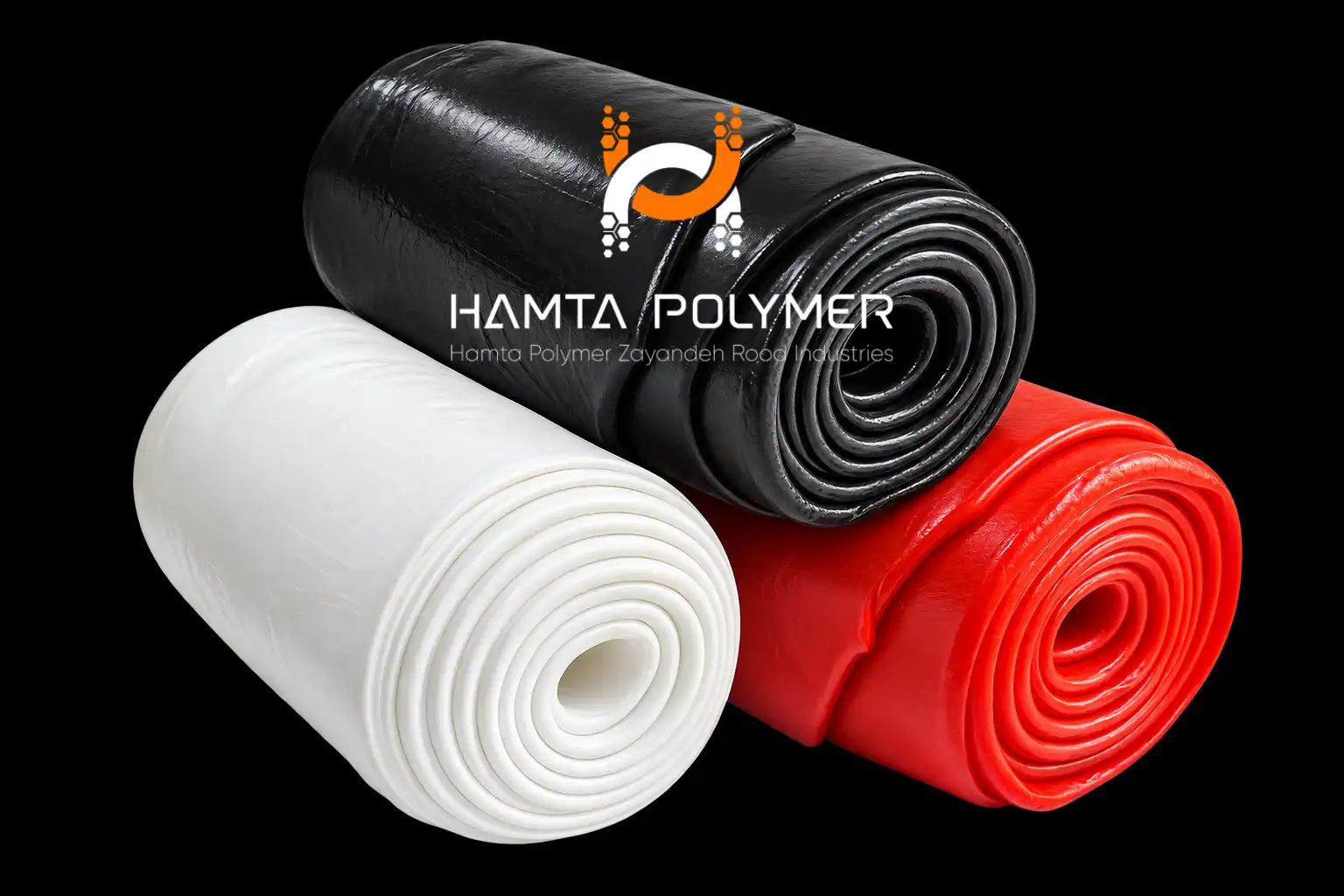
Silicone is considered where flexibility and sealing behaviour must be retained across a wide operating-temperature window, subject to compound review.
Its resistance to ozone, UV and weathering makes silicone relevant to outdoor and environmental-sealing applications.
A food, pharmaceutical or medical-contact statement requires a separately approved material grade and evidence; it is not implied by the base polymer family.
Choose a hardness grade to view the recorded mechanical properties, units and test references.
| Property | Symbol | Unit | Value | Standard |
|---|---|---|---|---|
| Hardness | H | Shore A | 50 +/- 5 | ASTM D2240 / ISO 7619 |
| Tensile strength | TS | MPa | >= 6.6 | ASTM D412 / ISO 37 |
| Elongation at break | EB | % | >= 350 | ASTM D412 / ISO 37 |
| 100% modulus | M100 | MPa | 0.7-1.4 | ASTM D412 / ISO 37 |
| Tear resistance | TR | kN/m | >= 16 | ASTM D624 / ISO 34 |
| Compression set (175 C / 22 h) | CS | % | 10-18 | ASTM D395-B / ISO 815 |
| Resilience | R | % | 45-60 | ISO 4662 |
| Specific gravity | rho | g/cm3 | 1.15 +/- 0.05 | ASTM D792 / ISO 2781 |
| Dielectric strength | Eb | kV/mm | >= 19 | ASTM D149 / IEC 60243 |
| Dielectric constant (1 MHz) | epsilon | - | 3.0-3.4 | ASTM D150 |
| Typical service temperature | T | C | -60 to +220 | - |
This is an orientation aid, not a final compatibility approval. Confirm the specific medium, concentration, temperature and exposure cycle with the technical team.
Values are typical laboratory guidance for the stated methods. Finished-part results can vary with formulation, cure, geometry and production conditions.
Silicone is not a default material for fuel, mineral oil or aromatic-solvent exposure. Assess an alternative family such as FVMQ, NBR or FKM against the actual medium.
Electrical performance must be checked on the finished insulation system, including geometry, voltage, environment and relevant applicable standards.
Food, pharmaceutical and medical-contact suitability is not implied. It needs a specified approved grade and the necessary evidence before any public claim or use.
These product families can be explored from the English product hub. Suitability is determined by the final application, not by the material code alone.
Share the medium, temperature range, electrical or environmental conditions, dimensions and target quantity with Hamta Polymer for an application-specific discussion.