
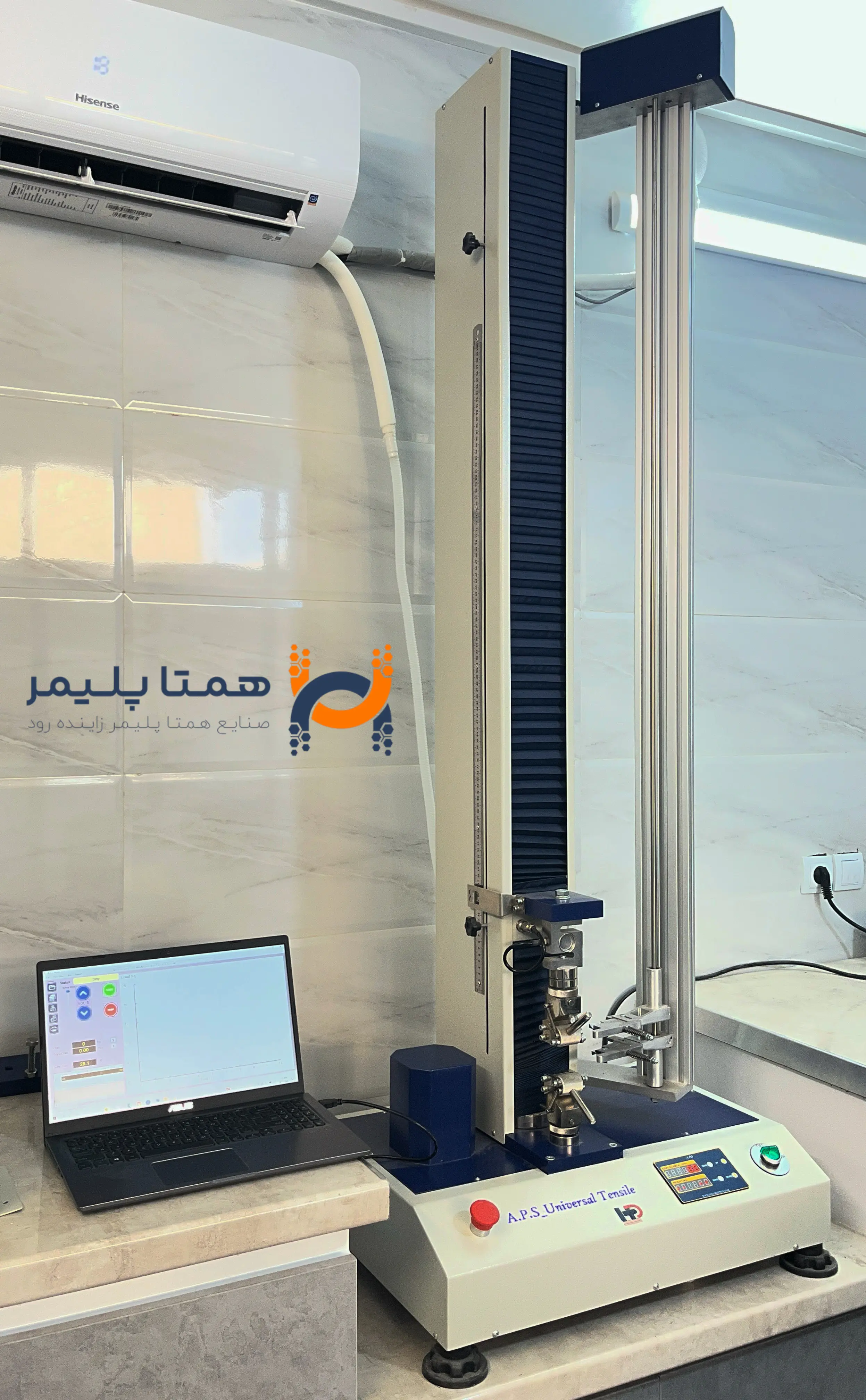
Rubber Tensile Test
RUBBER TENSILE TEST
Determine tensile strength, elongation at break and modulus of elastomers with calibrated tensile equipment and standard reporting.
Full test overview
Tensile testing is the principal comprehensive mechanical test for determining the physical properties of elastomers and their response to applied load. A standard dumb-bell or dog-bone specimen is extended at a uniform speed while the stress-strain curve is recorded. The curve provides the key values: ultimate tensile strength (UTS), elongation at break (EAB), and 100%, 200% and 300% moduli. The 100% modulus—the force required to extend the specimen to twice its original length—is used as an indicator of compound stiffness and is closely associated with crosslink density. A higher modulus can indicate a greater cure state and stiffer compound. Elongation above 300% commonly indicates good flexibility and the absence of over-cure. At Hamta Polymer, the tensile programme uses a digital tensile tester with a 5 kN capacity. Where the agreed method requires it, tests can be planned for low or elevated temperature using a thermal chamber.
Test images
Click or tap to enlargeTensile-test video
Without Tensile testing
A formulation or component-quality deviation may remain undetected until it reaches the customer.
With Tensile testing
In rubber-component manufacture, a small loss of tensile performance can lead to complete component failure in service. From O-rings and gaskets to dampers and industrial rubber parts, components may encounter tensile loads over their operating life.
Tensile testing in 5 steps — from specimen to result
Prepare specimens
Specimens are taken from the relevant batch. At least five standard dumb-bell specimens are cut, and thickness is measured at three points before controlled conditioning at 23 °C.
Set the instrument
The universal tensile tester is configured with suitable rubber grips, a 25 mm gauge length and a 500 mm/min crosshead speed. Ambient test conditions are recorded.
Run the test
Each specimen is mounted without pre-strain. Force and elongation are recorded continuously until rupture; a valid rupture location is verified according to the selected method.
Extract the stress-strain curve
The recorded curve is used to calculate tensile strength, elongation at break, 100%, 200% and 300% moduli and, where relevant, the M300/M100 ratio.
Review and report
The average of valid specimens is compared against the agreed technical requirement or reference method. The report records the curve, relevant parameters and the agreed conformity basis.
Using Tensile testing results in production improvement
Review cure state
The 100% modulus is associated with crosslink density. A result outside the agreed design range can indicate incomplete or excessive cure and should be reviewed with the full compound history.
Assess filler dispersion
The M300/M100 ratio can support review of strain hardening and the consistency of a reinforced compound when results are compared under equivalent conditions.
Identify variability
Low elongation or a large spread between specimens can support a targeted investigation of contamination, specimen quality, cure state or mixing consistency.
Test report structure
Illustrative NBR compound report structure — 70 Shore A target hardness; values shown are a presentation example, not a published product claim.
Test information
Measurement results
← drag| Parameter | Symbol | Value | Spec | Status |
|---|---|---|---|---|
| Tensile strength | TS | 18.2 MPa | ≥ 15.0 MPa | Pass |
| Elongation at break | EB% | 420% | 300%–500% | Pass |
| 100% modulus | M100 | 3.5 MPa | 2.5–4.5 MPa | Pass |
| 200% modulus | M200 | 7.1 MPa | — | Reported |
| 300% modulus | M300 | 11.8 MPa | ≥ 9.0 MPa | Pass |
| Modulus ratio | M300/M100 | 3.4 | 3.0–4.0 target | Pass |
| Rupture location | — | Within gauge section | — | Pass |
Test method
A Die C or Type 2 dumb-bell specimen is secured in the tensile grips and extended at 500 mm/min until rupture. Force and elongation are recorded continuously to generate the stress-strain curve.
Test conditions
Test temperature: 23 ± 2 °C. Crosshead speed: 500 ± 50 mm/min. Relative humidity: 50 ± 10%. Grip separation: 25 mm for Die C.
Technical details
Where it is used
Technical support
5 kN tensile tester with a documented force-measurement programme
Suitable grips selected to limit specimen slippage
Temperature-controlled programme can be scoped where required
Stress-strain curve and reported values retained together
Technical interpretation is tied to the agreed method, specimen and application context
Technical FAQ
A well-formulated NBR compound commonly has tensile strength in the 15–25 MPa range with 300–500% elongation. Carbon-black-reinforced NBR can reach about 28 MPa. Values below 10 MPa commonly warrant a review of formulation or cure conditions.
The 100% modulus indicates initial stiffness and cure state and is often important for seals. The 300% modulus describes response at higher strain and may be more relevant to highly extended products such as bellows and diaphragms.
A temperature-controlled programme can be agreed where the actual application requires it. The selected temperature range, conditioning and method must be recorded with the result.
Low elongation can be associated with over-cure, excessive reinforcement, polymer degradation or compound contamination. The result needs to be considered with the compound, cure history and other relevant tests.
Request Tensile testing
Share the material, sample condition, applicable standard and the decision this test should support.
Other laboratory tests
Rubber hardness testing
Accurate hardness measurement of rubber components on the Shore A and Shore D scales.
Fluid-exposure and swelling testing
Assessment of elastomer resistance to oils, fuels and chemical solvents.
Compression-set testing
Measurement of an elastomer's recovery after sustained compression at elevated temperature.