
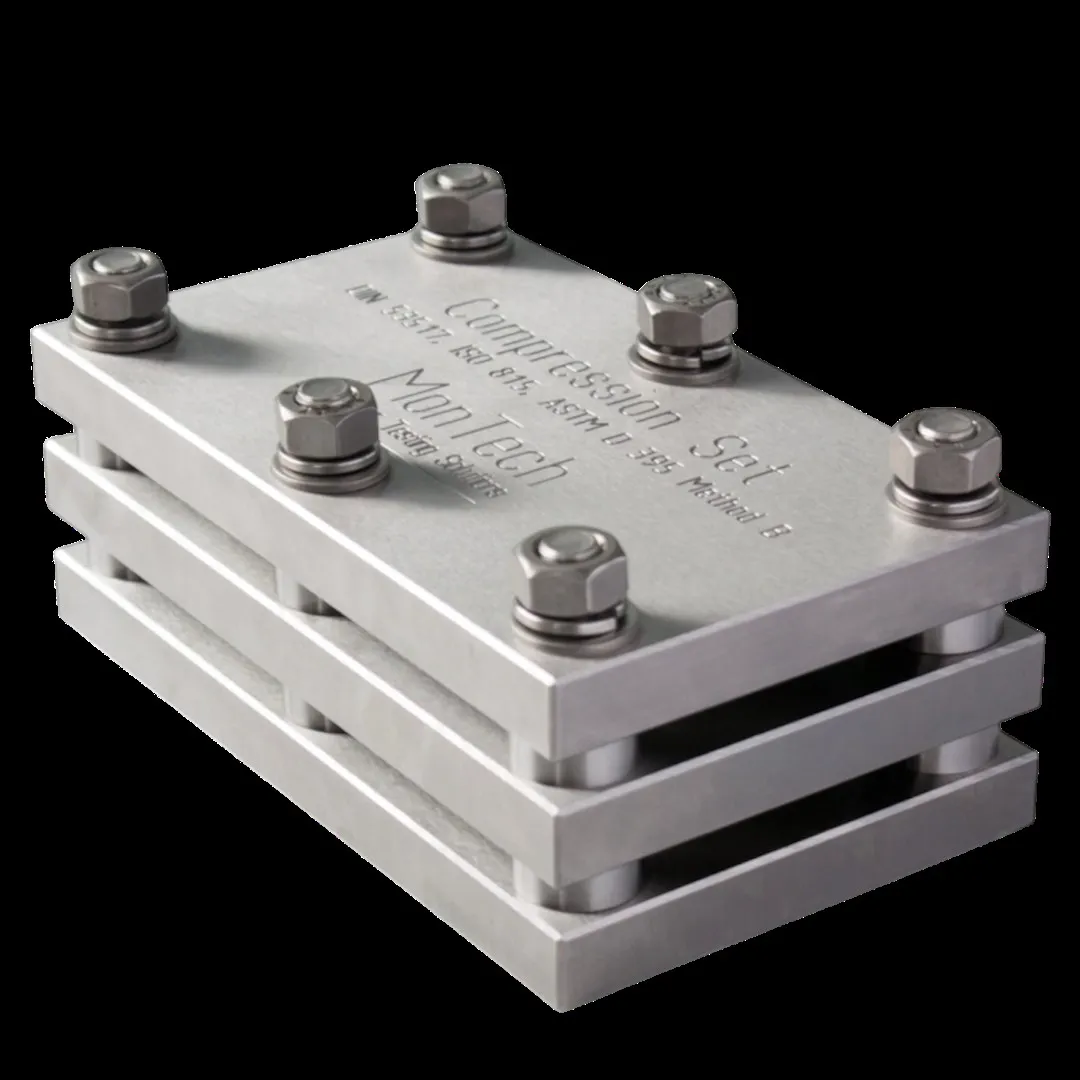
Compression Set Test
COMPRESSION SET TEST
Measure elastomer recovery after continuous compression at elevated temperature — per international standards.
Full test overview
Compression set is one of the most important tests for evaluating the long-term performance of rubber seals. Elastomers are viscoelastic: after extended compression they retain part of their deformation permanently. This residual deformation directly affects an O-ring's or gasket's ability to maintain sealing force; as compression set rises over time, leakage risk rises with it. Compression set is influenced by compound type and cure state, crosslink density, temperature and compression duration. Both under-cure and over-cure can increase permanent set. Efficient-vulcanisation systems, which form more stable monosulphidic crosslinks, can show lower compression set than conventional systems, subject to the complete formulation and duty. The Hamta Polymer programme applies fixed 25% compression in temperature-controlled ovens. After removal, the specimen is released and allowed the method-defined 30-minute recovery period at ambient test temperature before final height is measured.
Without Compression-set testing
A formulation or component-quality deviation may remain undetected until it reaches the customer.
With Compression-set testing
An O-ring can pass tensile testing yet start to leak after months in a hydraulic system because its compression set is too high. Compression-set testing is the established way to assess this recovery behaviour before installation, and is often required for oil, gas and automotive sealing applications.
Compression-set testing in 5 steps — from specimen to result
Prepare and measure the specimen
Type 1 cylindrical specimens, nominally 29 mm × 12.5 mm, are measured to ±0.05 mm. Initial height (h₀) is recorded at three points with a digital micrometer and averaged. The specimen faces must be parallel.
Compress with a calibrated spacer
The specimen is placed between lubricated metal plates. A calibrated metal spacer creates exactly 25% deflection under Method B; plate screws are tightened uniformly. Spacer height is h₀ × 0.75.
Hold in the oven
The compressed assembly is placed in a circulating-air oven at the controlled temperature, typically within ±1 °C. Common programmes include 70 °C / 22 h for standard NBR, 100 °C / 70 h for hotter duties and 200 °C / 70 h for FKM; the oven is stabilised before insertion.
Release and recover
The assembly is removed, fasteners are released promptly and the specimen is allowed to recover on a non-adherent surface at 23 °C for exactly 30 minutes. Consistent timing is essential because release delay changes the result.
Measure and calculate CS%
Final height (h) is measured with the same micrometer. CS% = ((h₀ − h) / (h₀ − hₛ)) × 100, where hₛ is spacer height. Zero denotes complete recovery and 100% no recovery.
Using Compression-set testing results in production improvement
Prediction of sealing life
A lower value is generally associated with better retention of sealing force; the design team must set the acceptance band for the actual pressure, temperature, geometry and required life rather than rely on a universal value.
Cure-system assessment
Compression set is highly sensitive to cure-system design. EV, semi-EV and conventional sulphur systems can exhibit materially different recovery behaviour, so the test supports selection of the appropriate system for the intended seal.
Supplier-change qualification
Changes in raw-material supply, such as sulphur or accelerator source, can affect compression set. Routine requalification testing after a defined change supports control of manufacturing risk.
Test report structure
Illustrative NBR semi-EV compound report structure — values shown are a presentation example, not a published product claim.
Test information
Measurement results
← drag| Parameter | Symbol | Value | Spec | Status |
|---|---|---|---|---|
| Initial height (h₀) | h₀ | 12.48 mm | — | Reported |
| Spacer height (hₛ) | hₛ | 9.36 mm | — | Reported |
| Final height (h) | h | 12.04 mm | — | Reported |
| Compression set, specimen 1 | CS₁ | 14.1% | ≤ 25% | Pass |
| Compression set, specimen 2 | CS₂ | 15.4% | ≤ 25% | Pass |
| Compression set, specimen 3 | CS₃ | 13.8% | ≤ 25% | Pass |
| Mean CS% | CS̄ | 14.4% | ≤ 25% | Pass |
Test method
Compress a cylindrical specimen by 25% between metal plates, hold it in an oven for the specified time and temperature, release it, then measure the recovered height after 30 minutes at ambient conditions.
Test conditions
Compression: 25% (Method B). Temperature: 70, 100, 150 or 200 °C. Duration: 22 or 70 h. Recovery: 30 min at 23 °C.
Technical details
Where it is used
Technical support
Temperature-controlled ovens with ±1 °C control across the test chamber
Calibrated spacers for the specified 25% compression
0.001 mm digital micrometer for height-change measurement
Multi-temperature programmes at 70, 100 and 150 °C can be scoped in one order
Interpretive report can identify technical actions where compression set requires improvement
Technical FAQ
For an NBR O-ring under a common 70 °C / 22 h programme, below 25% is often acceptable, below 15% is commonly considered good and below 10% excellent. FKM can retain a lower value at much higher temperatures, but the agreed method and actual duty determine acceptance.
Lower compression set generally means the O-ring retains sealing force more effectively. Results above 40% can indicate increased risk of early leakage; critical applications often require a tighter agreed limit such as 15% or lower.
An under-cured compound has lower crosslink density. Polymer chains have more freedom to relax while compressed and retain the deformed shape. A properly designed and cured network improves elastic recovery.
Yes. Efficient-vulcanisation systems, a suitable cure level, compatible coagents such as TAIC where technically appropriate, and controlled plasticiser content are common formulation approaches. Any change must be validated against all required properties, not compression set alone.
Request Compression-set testing
Share the material, sample condition, applicable standard and the decision this test should support.
Other laboratory tests
Rubber hardness testing
Accurate hardness measurement of rubber components on the Shore A and Shore D scales.
Tensile testing
Determination of tensile strength, elongation and modulus of elastomer materials.
Fluid-exposure and swelling testing
Assessment of elastomer resistance to oils, fuels and chemical solvents.