
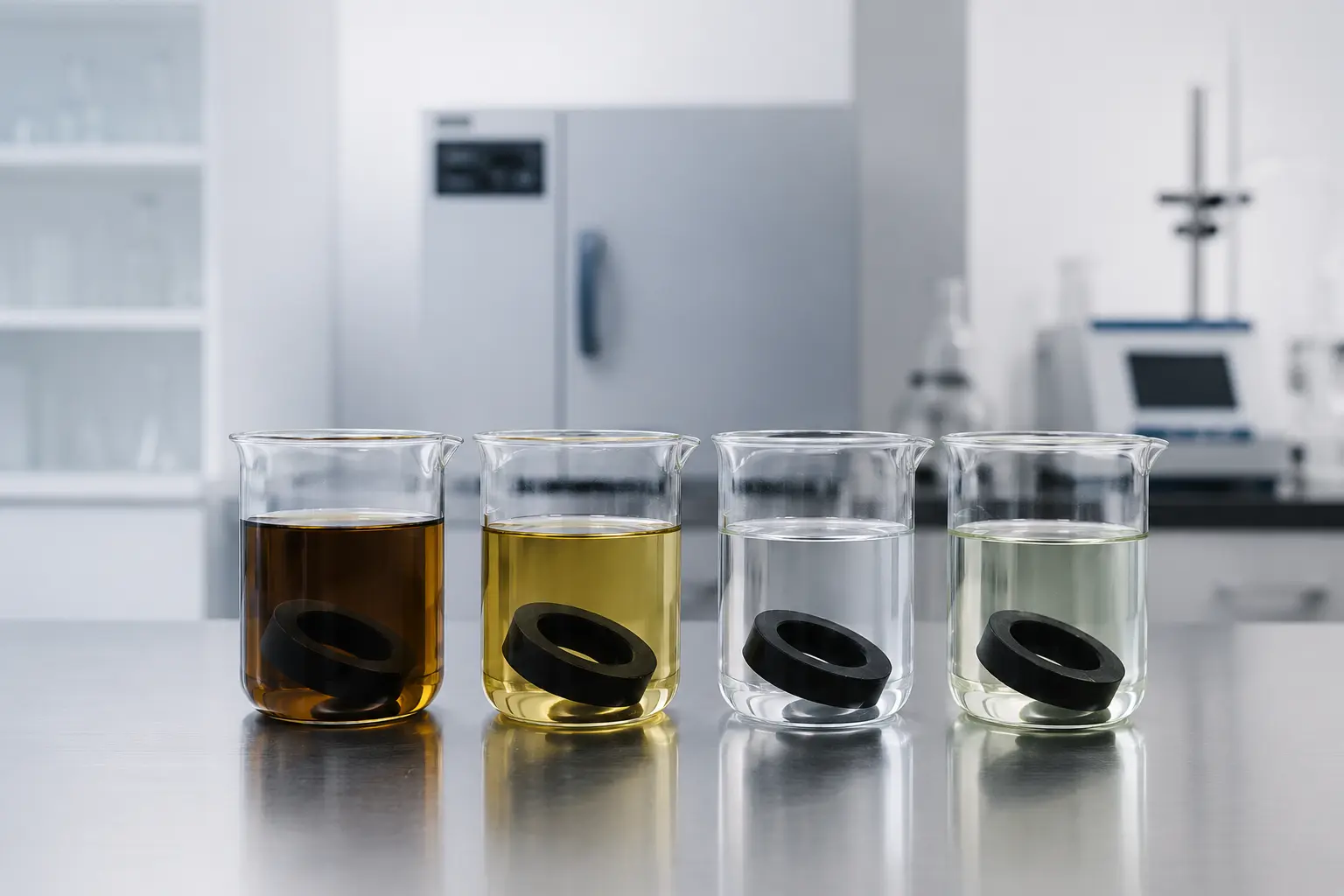
Elastomer Swelling / Immersion Test
RUBBER SWELLING / IMMERSION TEST
Assess elastomer resistance to oils, fuels and chemical solvents under controlled immersion with standard reporting.
Full test overview
The swelling or immersion test is a fundamental method for assessing the chemical compatibility of elastomers with service fluids. When rubber contacts an oil, fuel or solvent, molecules of the fluid may diffuse into the polymer network and cause swelling. The extent of that change depends on elastomer polarity, crosslink density (cure state) and the fluid itself. The practical principle of chemical affinity remains important: polar elastomers such as NBR are commonly selected for many non-polar mineral-oil duties, subject to the complete service conditions. A rubber specimen is immersed for a defined period—commonly 22 or 70 hours—in a standard reference fluid or an agreed customer fluid at controlled temperature. Standard reference media include IRM 901, 902 and 903 oils of differing severity, together with Fuel A, B and C. After exposure, mass, volume, hardness and dimensional changes are measured with the timing and handling specified by the method. Where the service medium is available, testing in the actual customer fluid can give a more representative basis for engineering selection than a reference fluid alone. This is particularly valuable when choosing O-ring, gearbox-gasket, engine-seal or hydraulic-seal materials for a defined operating environment.
Without Fluid-exposure and swelling testing
A formulation or component-quality deviation may remain undetected until it reaches the customer.
With Fluid-exposure and swelling testing
Selecting an O-ring material without fluid-exposure evidence can be comparable to fitting an unknown component into a high-pressure hydraulic system. Some elastomers can swell by more than 50% in an incompatible oil, lose their geometry and compromise sealing—often after the component is difficult to access. Immersion data gives an evidence-based basis for the material decision.
Fluid-exposure and swelling testing in 5 steps — from specimen to result
Record initial mass and dimensions
Specimens are weighed on an analytical balance with 0.001 g resolution. Dimensions are measured with a 0.01 mm digital calliper. These baseline values are used for all subsequent change calculations.
Select fluid and temperature
The reference medium is selected for the intended duty: IRM 903 may be used for a severe oil exposure programme, Fuel B for petrol-related exposure, and ASTM Oil No. 1 for lighter-oil conditions. Where supplied, the actual customer fluid can be used. The immersion temperature is set within the agreed programme, commonly from 23 to 150 °C.
Immerse under controlled conditions
Specimens are fully submerged in a closed vessel containing sufficient fluid, normally at least a 15:1 fluid-to-specimen volume ratio. The vessel is held in a controlled oven, typically within ±1 °C, for the agreed 22- or 70-hour duration.
Remove and wipe consistently
Specimens are removed with forceps and the surface is wiped with a clean lint-free material, not solvent. Measurements are taken within the method's specified post-removal window—commonly 1 to 5 minutes—so evaporation or further fluid loss does not distort the result.
Measure, calculate and assess
Mass, dimensions and Shore A hardness are re-measured. Volume change, mass change, hardness change and dimensional changes are calculated and compared with the agreed customer or component acceptance criteria.
Using Fluid-exposure and swelling testing results in production improvement
Evidence-based O-ring material selection
A practical starting guide is NBR for many mineral oils and diesel fuels, FKM for many synthetic oils and aromatic-fuel duties, EPDM for glycols and brake fluids, and silicone for silicone oils. The immersion test verifies suitability with measured data rather than material-family assumptions.
Detection of plasticiser extraction
A reduction in specimen mass after exposure can indicate that the fluid has extracted plasticisers from the compound. The resulting increase in hardness and loss of flexibility can be as significant to service performance as excessive swelling.
Testing in the real service fluid
Reference fluids are not always representative of the field medium. New synthetic oils, polyalphaolefin-based greases and biodegradable hydraulic fluids can behave very differently. Testing the actual customer fluid offers the most relevant exposure evidence.
Test report structure
Illustrative NBR 70 Shore A immersion-test report structure — values shown are a presentation example, not a published product claim.
Test information
Measurement results
← drag| Parameter | Symbol | Value | Spec | Status |
|---|---|---|---|---|
| Mass change | ΔW | +8.4% | ≤ +15% | Pass |
| Volume change | ΔV | +9.1% | ≤ +15% | Pass |
| Hardness change | ΔH | −4 Shore A | −10 to +5 | Pass |
| Length change | ΔL | +3.0% | — | Reported |
| Width change | ΔW | +2.8% | — | Reported |
| Thickness change | ΔT | +3.3% | — | Reported |
| Visual condition | — | No cracking or colour change observed | — | Pass |
Test method
A specimen is weighed and dimensioned before immersion in a selected reference fluid (such as IRM 903 oil or Fuel B) or the customer's service fluid at the specified temperature. On removal, the surface is carefully wiped without solvent and the changes in mass, volume and hardness are recorded.
Test conditions
Immersion temperature: 23, 70, 100 or 150 °C as agreed. Typical duration: 22 or 70 hours. Fluid: standard reference medium or the customer's actual service fluid.
Technical details
Where it is used
Technical support
Analytical balance with 0.001 g resolution for mass-change measurement
Multiple ovens for parallel exposure programmes at different temperatures and in different fluids
Customer-fluid exposure can be included within the agreed scope
Seven-parameter report structure: mass, volume, hardness, three dimensions and visual condition
Combined immersion and ageing programme can be defined to simulate the relevant hydraulic-seal duty
Technical FAQ
The acceptance limit is set by the component design and duty. A volume change up to about +15% is often used as a general screening criterion; around 10% or lower is commonly preferred, while critical oil-and-gas duties may require a tighter agreed limit. Shrinkage can be as problematic as swelling and must also be evaluated.
Yes. A customer may provide the service medium and the exposure programme can be defined around that fluid. This can be more representative than a reference liquid, particularly for synthetic oils or proprietary fluid blends.
FKM is widely used where broad resistance to mineral oils, many synthetic oils and fuels is required. NBR is a cost-effective choice for many conventional oil and fuel applications. EPDM is generally suitable for glycol-based media and brake fluids but is not normally selected for mineral-oil service. Final selection still requires the actual fluid, temperature, pressure and exposure time.
The fluid may extract plasticisers or other soluble ingredients from the compound. This plasticiser extraction can reduce mass, increase hardness and reduce flexibility; it needs the same engineering attention as excessive positive swelling.
Request Fluid-exposure and swelling testing
Share the material, sample condition, applicable standard and the decision this test should support.
Other laboratory tests
Rubber hardness testing
Accurate hardness measurement of rubber components on the Shore A and Shore D scales.
Tensile testing
Determination of tensile strength, elongation and modulus of elastomer materials.
Compression-set testing
Measurement of an elastomer's recovery after sustained compression at elevated temperature.