
Blend-led tuning
NR/SBR ratio, filler system and cure design are tuned to the required balance of dynamic response, abrasion and cost.
A technical reference for Hamta Polymer NR/SBR blend compounds from 40 to 90 Shore A. The blend is evaluated when an application needs a practical balance of NR resilience and SBR abrasion behaviour. Blend ratio and reinforcement are selected for the final duty.
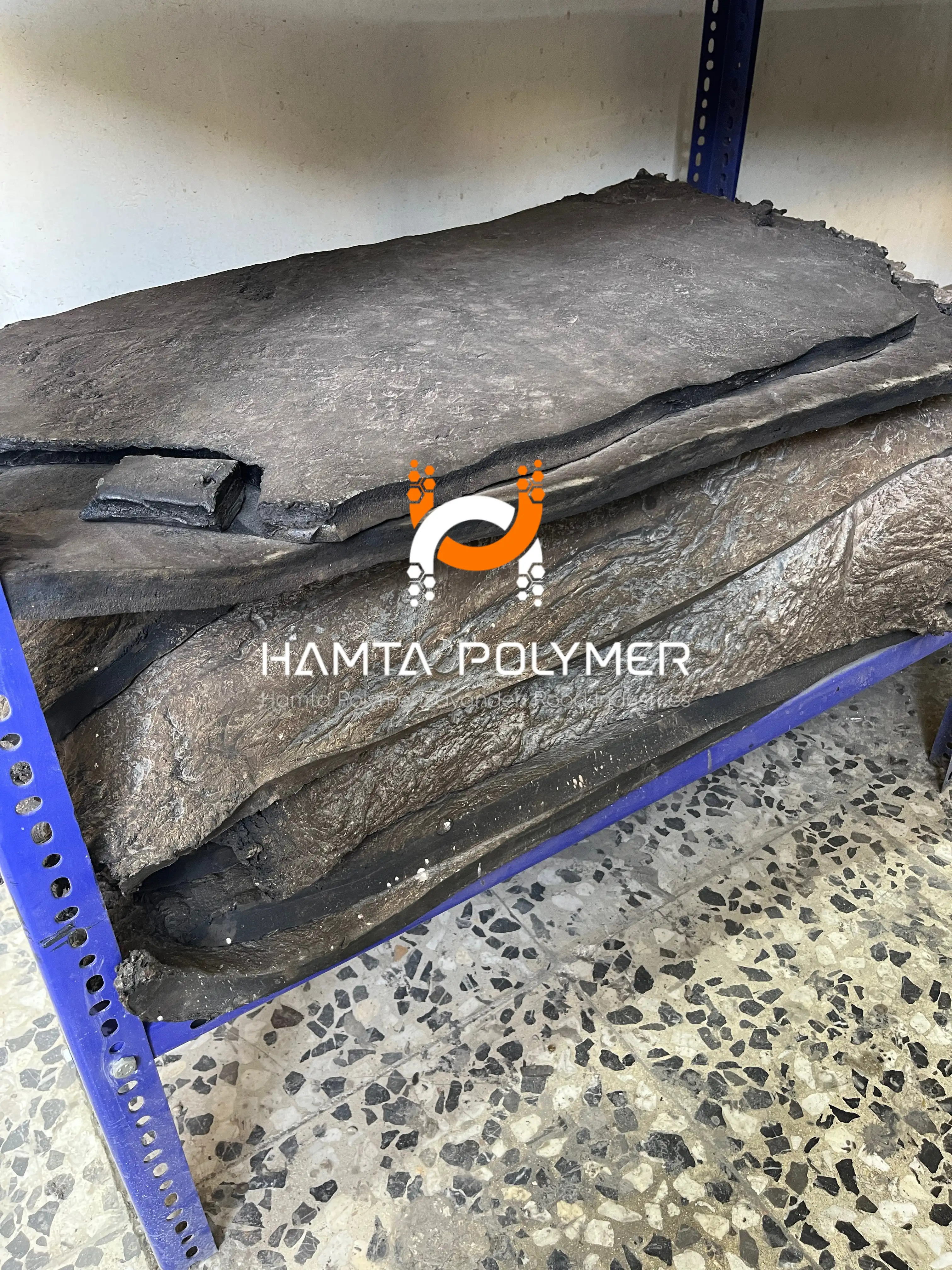
NR/SBR ratio, filler system and cure design are tuned to the required balance of dynamic response, abrasion and cost.
It is assessed for general mechanical components where neither pure NR nor pure SBR alone is the preferred balance.
Oil, weathering and heat resistance must be checked against the exact finished-part service conditions.
Choose a hardness grade to view the recorded mechanical properties, units and test references.
| Property | Symbol | Unit | Value | Standard |
|---|---|---|---|---|
| Hardness | H | Shore A | 70 +/- 5 | ASTM D2240 / ISO 7619 |
| Tensile strength | TS | MPa | ≥ 20.0 | ASTM D412 / ISO 37 |
| Elongation at break | EB | % | ≥ 400 | ASTM D412 / ISO 37 |
| 100% modulus | M100 | MPa | 2.5 – 4.5 | ASTM D412 / ISO 37 |
| Tear resistance | TR | kN/m | ≥ 45 | ASTM D624 / ISO 34 |
| Compression set | CS | % | 14 – 22 | ASTM D395-B / ISO 815 |
| Resilience | R | % | 52 – 62 | ISO 4662 |
| Recorded technical property | ρ | g/cm³ | 1.16 +/- 0.02 | ASTM D792 / ISO 2781 |
| Abrasion resistance | Abr | mm³ | ≤ 95 | ISO 4649 |
| Hardness change after ageing | ΔH | point | +4 to +9 | ASTM D573 / ISO 188 |
| Typical service temperature | T | °C | -30 ~ +85 | - |
This is an orientation aid, not a final compatibility approval. Confirm the specific medium, concentration, temperature and exposure cycle with the technical team.
Values are typical laboratory guidance for the stated test methods. Finished-part results can vary with formulation, cure, geometry and production conditions.
The NR/SBR ratio is application-specific. Do not infer final behaviour from the blend name without reviewing the required dynamic, abrasion and environmental conditions.
Material selection must be confirmed against the actual medium, temperature cycle, load, motion and relevant product requirements before final approval.
Material codes, numerical values, units and standards are shared technical identifiers; the explanatory English copy is authored for this page.
These product families can be explored from the English product hub. Suitability is determined by the final application, not by the material code alone.
Share the load cycle, abrasion conditions, temperature and target quantity with Hamta Polymer for an application-specific discussion.