
Heat and fluid resistance
Hydrogenation reduces the remaining double bonds in nitrile rubber, supporting higher-temperature service and improved resistance to heat ageing when compared with standard NBR.
A technical reference for Hamta Polymer HNBR compounds from 50 to 90 Shore A. HNBR is considered when an application needs the oil resistance associated with nitrile rubber together with stronger heat, abrasion and sour-gas performance. Final selection must be confirmed for the finished-part service conditions.
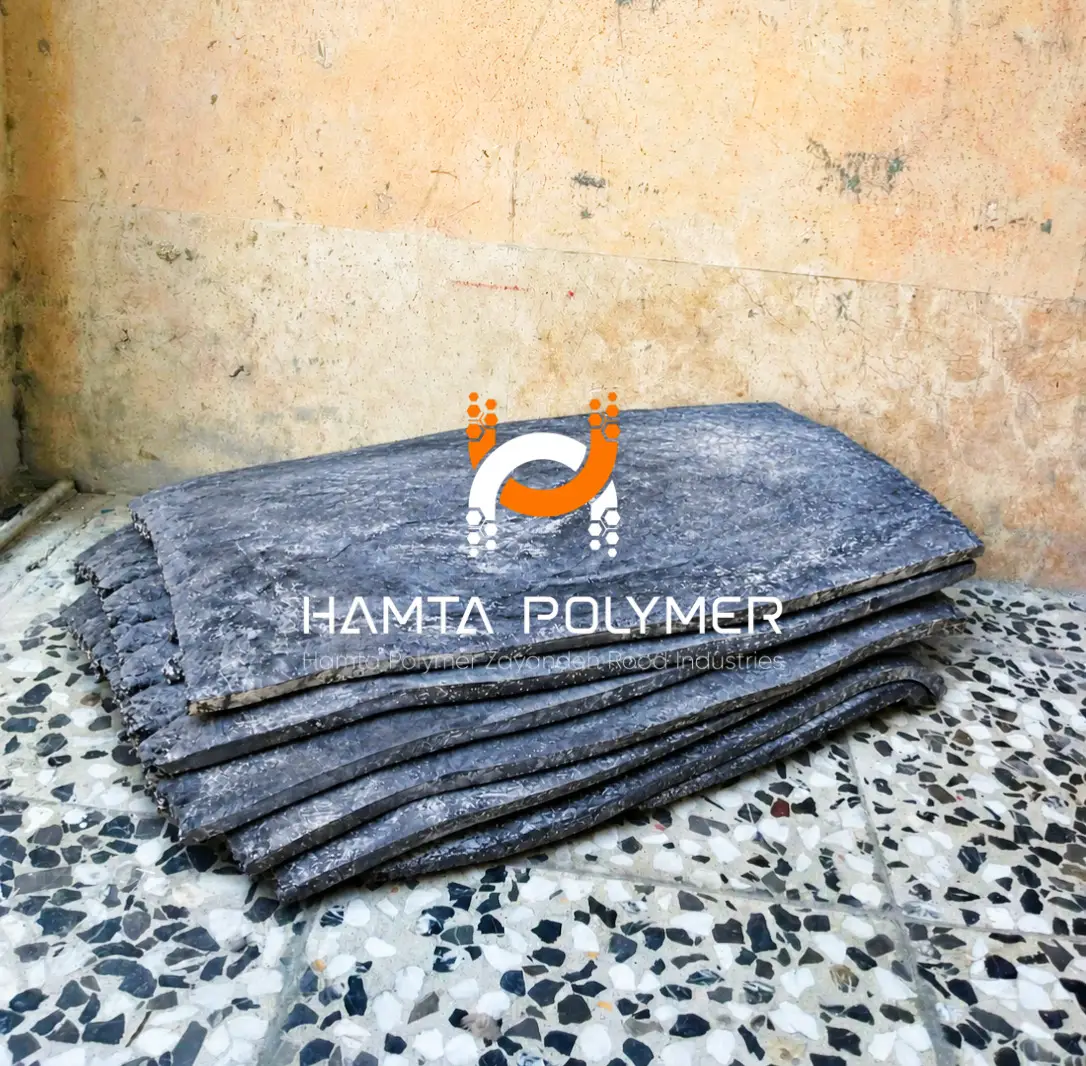
Hydrogenation reduces the remaining double bonds in nitrile rubber, supporting higher-temperature service and improved resistance to heat ageing when compared with standard NBR.
The abrasion and compression-set profile makes HNBR a material family to assess for demanding seals, bearing elements and other dynamic industrial parts.
Fluid chemistry, H2S concentration, pressure, motion, temperature cycle and cure system all affect suitability. A material code is not a final approval.
Choose a hardness grade to view the recorded mechanical properties, units and test references.
| Property | Symbol | Unit | Value | Standard |
|---|---|---|---|---|
| Hardness | H | Shore A | 80 +/- 5 | ASTM D2240 / ISO 7619 |
| Tensile strength | TS | MPa | >= 21.0 | ASTM D412 / ISO 37 |
| Elongation at break | EB | % | >= 200 | ASTM D412 / ISO 37 |
| 100% modulus | M100 | MPa | 5.0-10.0 | ASTM D412 / ISO 37 |
| Tear resistance | TR | kN/m | >= 44 | ASTM D624 / ISO 34 |
| Compression set (150 C / 24 h) | CS | % | 14-25 | ASTM D395-B / ISO 815 |
| Resilience | R | % | 40-50 | ISO 4662 |
| Specific gravity | rho | g/cm3 | 1.26 +/- 0.03 | ASTM D792 / ISO 2781 |
| Abrasion resistance | Abr | mm3 | <= 50 | ISO 4649 |
| Oil volume change (IRM 903, 150 C / 70 h) | AV | % | <= 6.0 | ISO 1817 |
| Typical service temperature | T | C | -35 to +160 | - |
This is an orientation aid, not a final compatibility approval. Confirm the specific medium, concentration, temperature and exposure cycle with the technical team.
Values are typical laboratory guidance for the stated test methods. Finished-part results can vary with formulation, cure, geometry and production conditions.
HNBR is produced by hydrogenating NBR. The resulting material family is commonly selected for stronger heat-ageing and chemical-resistance requirements than standard nitrile rubber.
For dynamic sealing, validate compression set, extrusion risk, mating surface, lubrication and temperature cycle on the actual assembly.
For service above the stated range or aggressive fluids, review alternatives such as FKM with the technical team before making a material decision.
These product families can be explored from the English product hub. Suitability is determined by the final application, not by the material code alone.
Share the medium, temperature range, pressure, motion, dimensions and target quantity with Hamta Polymer for an application-specific discussion.